
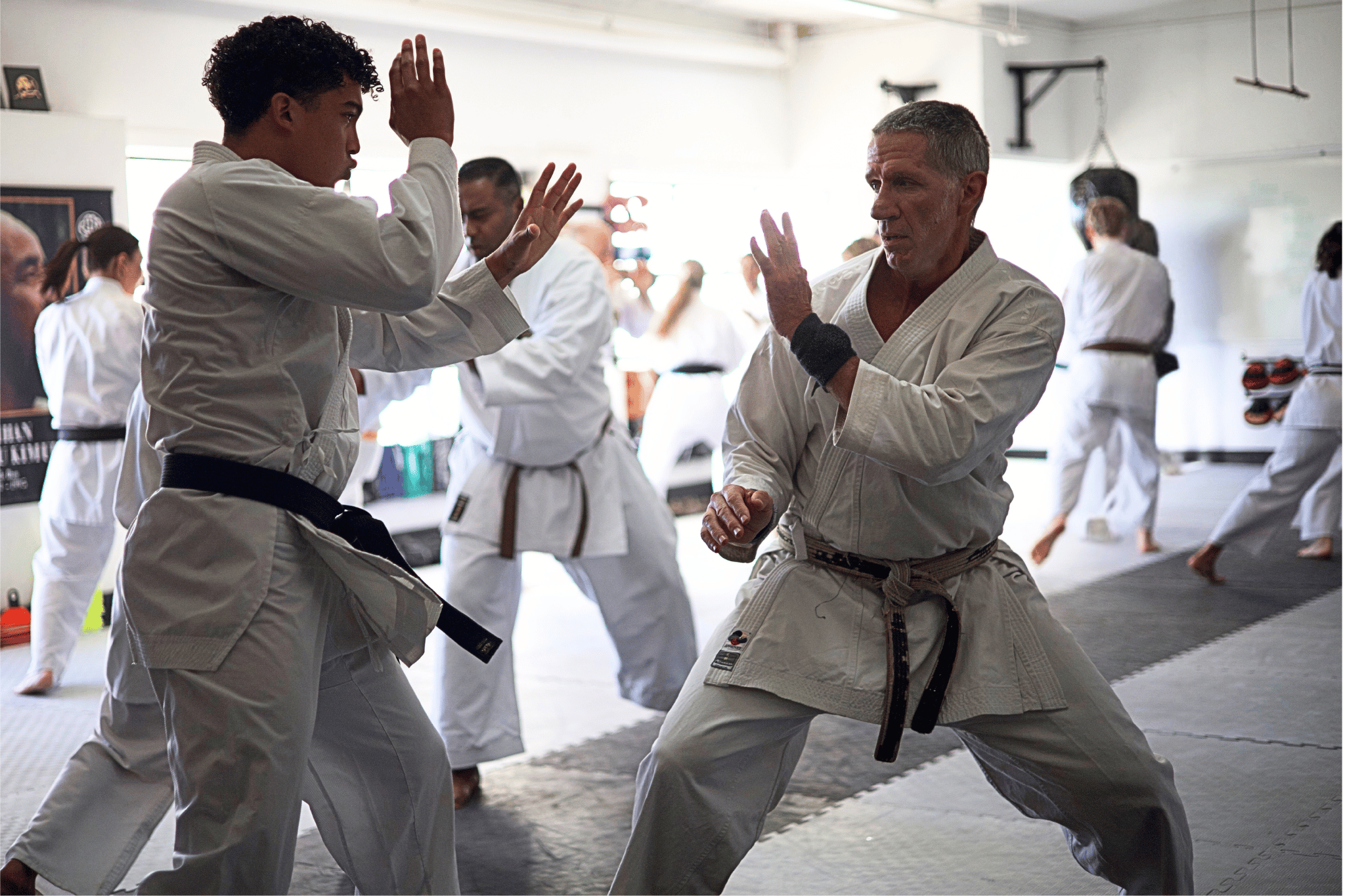
In kumite, it can feel natural to lean forward toward the target or the gap. But Shihan Chris’s message is simple and important: keep the weight on the back leg. That doesn’t mean standing stiffly or not moving forward; it means staying loaded, balanced, and ready to move in any direction. A rear-loaded stance stores energy in the back leg and makes it easier to forestall or counter-attack.
Balance before speed
Kumite rewards the fighter who can change direction faster than your opponent expects. If your weight drifts onto the front leg, your body has already committed forward. You may reach the target, but you also become easier to sweep, forestall, or pull off balance.
Keeping more weight over the rear leg gives you a stable base while leaving the front foot light and mobile. That light front leg can check distance, set up an attack, or move you out of danger. A low base supports both stability and fast attacking action.
The back leg is the engine
Power in karate does not begin in the fist. It travels from the ground, through the legs and hips, and into the technique. Using the whole body adds reach, power, and stability to a punch or kick. If you are already leaning forward, much of that engine has been spent before the technique begins.
Think of the rear leg as a compressed spring. When it’s bowed, engaged, and carrying most of your weight, it can drive the hips forward, give power to the punch, launch a kick, or move you back out of range. When the weight is back, you can retreat, change the angle, or absorb your opponent’s pressure without losing your structure.
Better distance, better defence
This is especially useful against a taller, stronger, or more aggressive opponent. Shifting back or off the line can reduce the momentum coming at you. In other words, the back leg doesn’t just protect you – it buys you time.
Faster attacks, not slower ones
Students sometimes think that keeping the weight back makes them slower to attack. The opposite is usually true. Because the rear leg is loaded, it can push you forward explosively the moment an opening appears.
The key is to attack from the back leg, not by falling forward from the front leg. Push from the rear foot, rotate the hips, deliver the technique, and then return to your ready position. This lets you strike without leaving yourself open after the attack.
Avoid the “falling punch”
A common kumite habit is the “falling punch”: the front foot steps in, the body leans after it, and the technique arrives with momentum but little control. It may look aggressive, but it often creates problems:
- The front knee takes extra load
- The hips are left behind
- The head and chest move in toward the opponent
- Recovery is slower after the attack
- The fighter is more vulnerable to a counter, sweep, or clinch.
Keeping the weight back helps the upper body stay over the hips and the hips stay over the base. That alignment is what turns speed into controlled speed.
What “weight back” should feel like
It should feel active, not passive. Your rear leg is bowed and ready; your front leg is light but not empty; your alignment is upright; and your hips remain mobile.
A useful training image is: “Sit into the back leg, then send the technique from it.” In other words, stay loaded behind your centre of gravity.
Simple drills to try
- Check the front knee: If it is collapsing inward or carrying all your weight, reset the stance.
- Feel the rear foot grip the floor: The back leg should push, not merely support.
- Keep the head over the hips: Do not let the chest lead the attack.
- Practise moving out from the rear leg: Step in, strike, and return without leaning.
- Train distance control: Let the front foot measure the range while the back leg remains ready to drive.
The bigger lesson
Keeping the weight on the back leg teaches something larger than footwork: do not give away your balance for the sake of aggression. In kumite, the fighter who remains composed can choose the moment to attack, and can recover immediately afterwards.
So when Shihan says, “Keep the weight on the back leg,” he is not asking students to hold back. He is asking them to be ready: balanced, powerful, mobile, and dangerous from a position of control.