
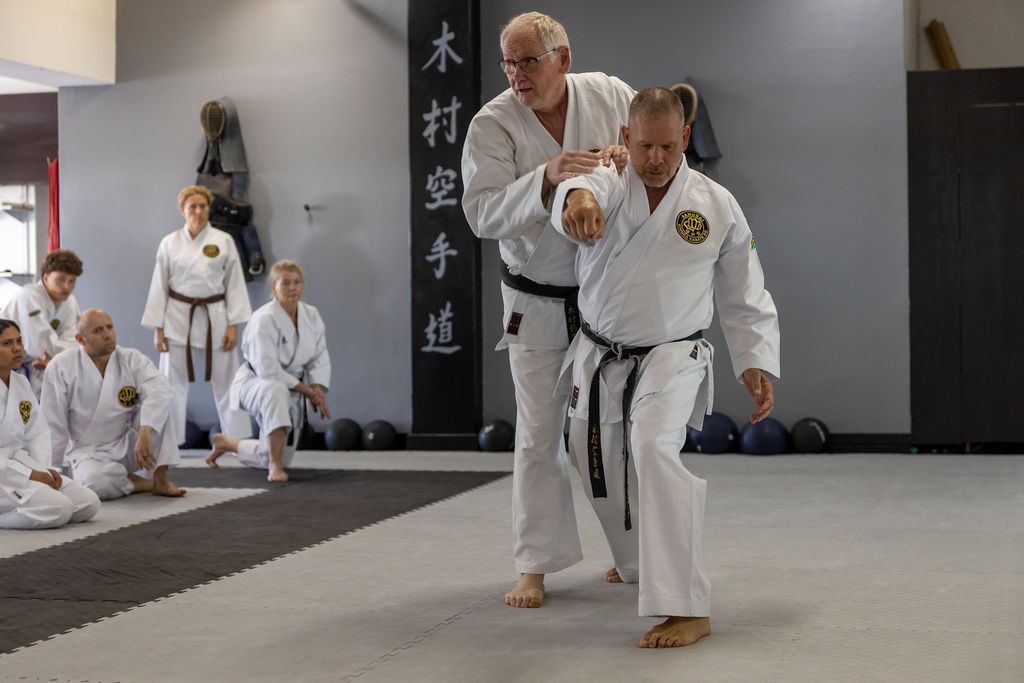
Karate doesn’t just slow the ageing process. It reshapes it.
That’s the promise of karate for age 40+ practitioners. But to get there, you need to understand what’s happening under the skin.
The hidden cost of “old man strength”
There’s a certain kind of strength that comes with age. It’s the “old man strength” people joke about: dense, unyielding, built from years of labour and lifting. But there’s a hidden cost to that kind of power. Without care, it can become stiff, brittle, and prone to breaking under pressure.
Fascia is the body’s web of connective tissue, naturally losing hydration and elasticity with age. Layers that should glide begin to stick and movement becomes compartmentalised. This is why some older adults feel strong but move stiffly – their strength is localised, not integrated. Think of it as the difference between a rope that bends and a branch that snaps.
Karate as fascial training
Karate is built on whole-body movement. A correctly performed kata is a continuous sequence of weight shifts, rotations, and directional changes. Force travels along the total length of the body’s myofascial connections, loading the system through a full range of motion under sustained tension.
This is exactly the stimulus fascia needs to maintain hydration, elasticity, and sliding capacity. Training slow, deliberate transitions can be particularly valuable for stabilisers, fascial chains, and the proprioceptive system.
Research supports this. A five-week adapted karate trial among older adults (ages 59–90) showed measurable improvements in balance, neuromuscular control, and strength. Whole-body movement enhanced postural control and functional fitness in ways that isolated gym exercises often miss.
You still need a little snap
Here’s where it gets interesting. While slow, fluid work is essential for fascia, you don’t want to neglect explosive or plyometric training altogether. Power is one of the first qualities to diminish as we age. Fast-twitch muscle fibres shrink and slow down, tendons and fascia lose elasticity, and neuromuscular efficiency declines.
Plyometric training – controlled, explosive movements – trains your body to produce force quickly. It enhances the elasticity of muscles, tendons, and fascia by promoting rapid transitions between stretching and contracting.
In practical terms, this means better reaction time, stronger joints, and functional power that carries into daily life.
Building a balanced practice
Here’s how to prioritise fascial health while keeping your snap:
For fluidity and flow
- Slow stance work: Hold positions with awareness, feeling the tension travel through fascial chains.
- Controlled kata: Focus on smooth transitions, not speed or power.
- Barefoot basics: Train proprioception and foot fascia by working without shoes.
- Coordinated breathing: Use deep abdominal breathing to support fluid movement and hydration.
- Conscious relaxation: Release tension between techniques to allow fascia to rebound.
For power and resilience
- Low-level plyometrics: Add hops, skips, or medicine-ball throws to build elastic ability.
- Explosive basics: Practice quick, controlled strikes or kicks to train fast-twitch fibres.
- Progressive loading: Start small and build gradually to strengthen joints and tendons without wear and tear.
- Functional drills: Include movements that mimic kumite demands, like quick direction changes or reactive footwork.
Karate reshapes aging by keeping the body’s connective tissue hydrated, elastic, and integrated. The real prize is not the ability to lift more, but the capacity to move well and react quickly.